July 28 – Copenhagen to Gedser, Denmark (145 km, 90 miles)

Posted in On the Road on July 28, 2010 by Scott McGee

Bike path between Copenhagen and Gedser, Denmark.

.

Today was the first real leg of the trip by bike, from Copenhagen to Gedser, at the southern tip of Denmark, and due north of Rostock, Germany. It was sunny and hot (25 degrees C is hot for an Alaskan) for most of the day. I originally thought it would be about a day and a half ride to Gedser, but since Denmark is relatively flat, I was able to ride the whole way today. As I was approaching Gedser dark rain clouds developed in the direction I had to go. When I was within 7 kilometers of Gedser the rain came down quick and hard. The road ran through wheat fields and there was no shelter except for a clump of trees about a kilometer away, so I pedaled like crazy to get into the shelter of the trees to wait out the sudden downpour. After waiting 30 minutes there was no let up, so I gave up waiting, put on the raingear, and continued on for the final 7 kilometers.

.

Have you ever seen a Mercedes-Benz taxi cab in the U.S.? Most likely, not. But they seemed to be fairly common in Denmark.

.
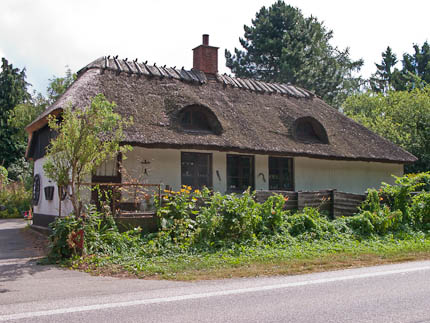
A typical Danish thatch-roofed house.

.

I thought Gedser was going to be a fairly substantial town, since it’s a jumping off point for the ferry route to Germany. So I was really surprised to find that there are very few businesses, and everything except the one hotel in town was closed. Since there wasn’t a campground nearby, and because I wasn’t too crazy about setting up a rogue camp in some farmer’s field in the rain, I opted for a room in the hotel. So I had good accommodations for the night, was able to shower and do laundry, but unfortunately the one grocery store in town was closed. The only food I had was three plums that I bought along the way. So that was dinner. But on the bright side, the hotel manager told me that the ferry from Gedser to Rostock has a huge, free breakfast buffet. So I’m really looking forward to breakfast in the morning.

.

This is one of the blades of a wind-power generator, with my bike shown for scale. These things are huge - about 2 meters in diameter and about 50 meters long.

.

I have to say that Norway, Sweden, and Denmark have a superb cycling infrastructure. Nearly everywhere, there are designated bike lanes and trails. In the towns, bike lanes are to the right of the traffic lanes, and are often physically separated from the traffic by a curb. And then to the right of the bike lanes are the sidewalks, which are in turn separated from the bike lane by another curb. Signaled intersections have designated lanes for cyclists, and motorists respect the bike lanes and yield to bikers. Very nice. And a note about the traffic lights in Denmark – the cycle is from green directly to red. Then from red it goes to a one second yellow light followed by green. Completely opposite our lights in the States. Then there are the numerous roundabouts. Between Copenhagen and Gedser, I think there were actually more roundabouts than signaled intersections. And each roundabout had a designated bike lane which made it very simple and safe to get around it. Makes me wonder when we’ll wake up in the U.S. and adopt this efficient method of getting traffic through intersections. The Europeans are way ahead of us in this regard.

.

Interesting things to see in southern Denmark.

.

Tomorrow morning I’ll board a ferry for the two hour trip across a narrow section of the Baltic Sea to Germany.
July 27 – Oslo to Copenhagen (676 km, 420 miles)

Posted in On the Road on July 27, 2010 by Scott McGee

.

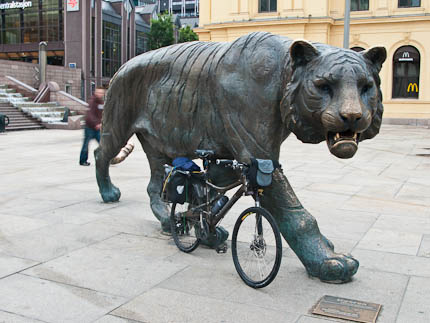
Tiger statue in the square at the Oslo train station, with my bike for scale.

.

I got up at 5:00 am this morning in order to catch the morning train from Oslo to Copenhagen, which was actually a three-stage trip. The first train was from Oslo to 70 km north of Goteborg, Sweden. Due to track construction, they had to unload everyone – probably 500 people – from the train and bus us all to the Goteborg train station where we boarded a second train for the final leg to Copenhagen. After unloading my 66 pounds of bike and gear from the train, I had to get from the track level up to the street. There were two options – stairs and an elevator. I opted for the elevator and when the doors opened I was greeted by two guys sitting on the floor with drugs and syringes scattered around them. I asked, “Going up?” (kind of a metaphorical question now that I think about it) and they said something about making themselves feel better. But they didn’t mind when I wheeled my bike into the elevator and pushed the “up” button. Interesting.

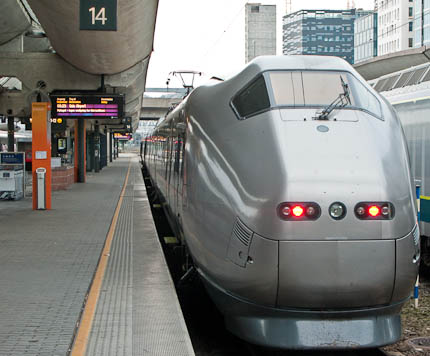
The trains here are amazing – they’re everywhere, and they’re fast. The two I was on were the high-speed tilting-body type. The cars of the train would automatically tilt, or lean into the curve, like when riding a bike and you lean over when rounding a corner. I had my GPS going the entire trip and the maximum speed reached was 127 miles per hour! Sure didn’t seem that fast, until we’d get to an area where the highway paralleled the train tracks. It was just amazing to be on a train, blowing past all the cars and trucks on the highway. And as high-speed trains go, these aren’t even anywhere near the fastest – the fastest can easily top 250 mph.

.

The business end of the high-speed train from Oslo to Copenhagen. This train hit a top speed of 204 kilometers per hour (127 miles per hour)!

.

Portland, Oregon likes to boast that it’s the most bike-friendly city in the U.S., but it’s nothing compared to Copenhagen. There are bikes everywhere here – I’ve never seen so many people riding bikes. There seemed to be almost as many bikes as cars. There are designated bike lanes on all the roads, so it’s easy to get where you need to go. It seems the biggest danger is not the cars, but the faster cyclists that are always on your tail and whipping around you with inches to spare. It kind of reminded me of a NASCAR race, with everyone all bunched up at the intersections waiting for the light to change, and then jockeying for a more advantageous position in the lineup before reaching the next intersection. Wild times, for sure.

.

A sea of bikes in Copenhagen. I've never seen so many bikes in one place at one time.

.

A typical bike lane in Copenhagen. The road is on the left, the bike lane in the middle, and the pedestrian sidewalk is on the right. This system works very well to physically separate cars from bikes from pedestrians.

.

Intersection in Copenhagen. The bike lane is designated by the blue paint on the pavement. This keeps bikes in view of vehicles, but safely to the right of them, and at the same time out of the pedestrian crosswalk. A very nice system. The U.S. could learn a lot from the Euporeans with respect to bicycle infrastructure in the cities.

On the schedule for tomorrow – from Copenhagen to points south.

July 26 – Oslo Airport to Oslo (64 km, 40 miles)

Posted in Norway, On the Road on July 26, 2010 by Scott McGee

When I woke up this morning it was still raining and the top of the airport control tower was in the clouds. I wasn’t too excited about pedaling in the rain today, but the thought of staying near the airport another day was less appealing. So I packed up my stuff and set off on the first leg of the trip – approximately 30 miles from the airport to downtown Oslo. It rained for about half the trip and had stopped by the time I got to Oslo. Although I’d like to pedal the entire distance to Rome, it’s not really feasible given my available time and the desire to stop and visit friends along the way. So I’ve decided to take trains at the beginning and end of the trip. This way I can quickly cover some distance, leaving more time for the ride from Copenhagen to Genova, Italy. I stopped at the train station in Oslo and reserved a seat for tomorrow on the train from Oslo to Copenhagen.

.

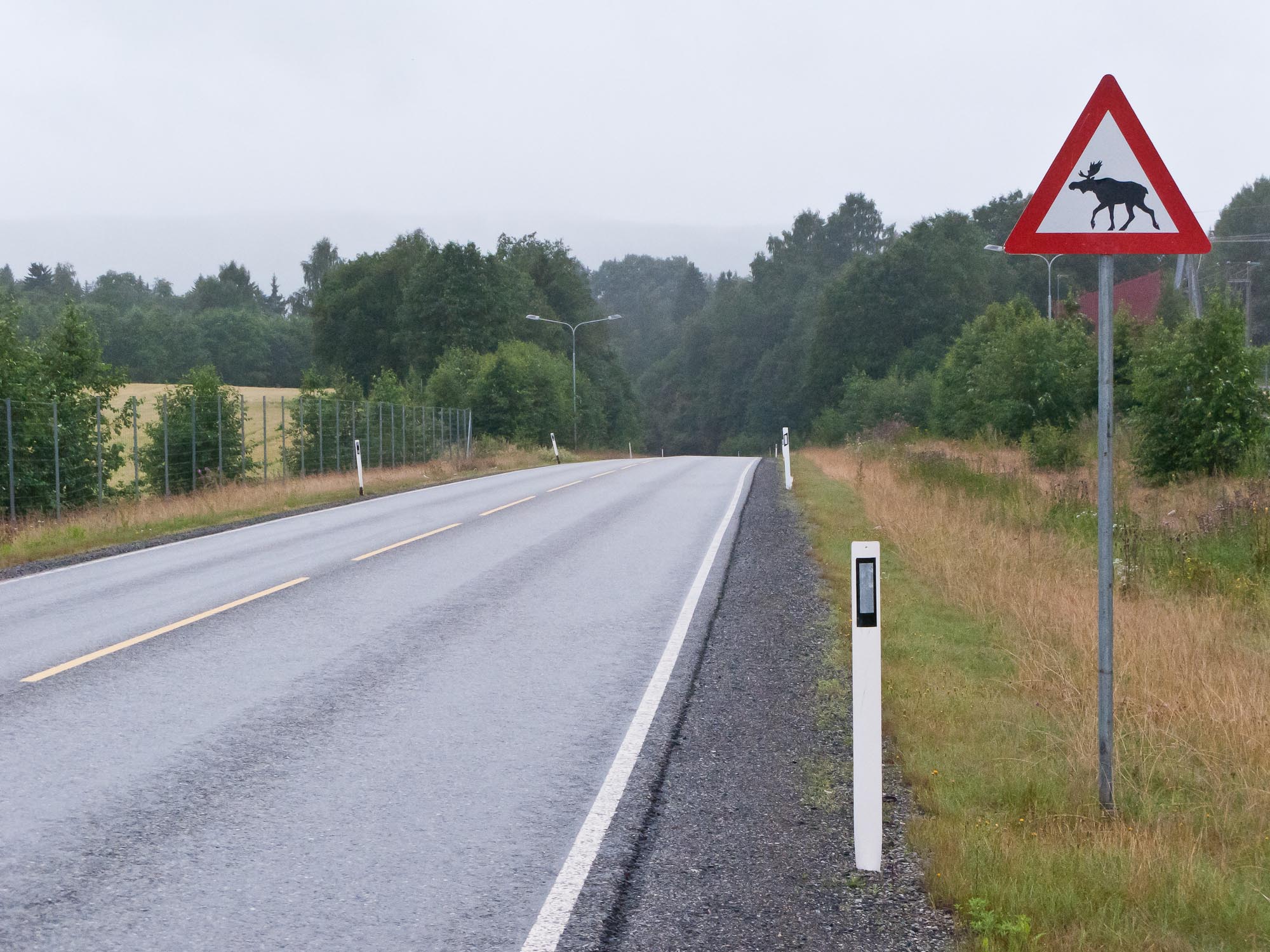
Hey, this sign looks familiar. We have moose signs in Alaska also. This one is along the road between the Oslo airport and Oslo. ^

.

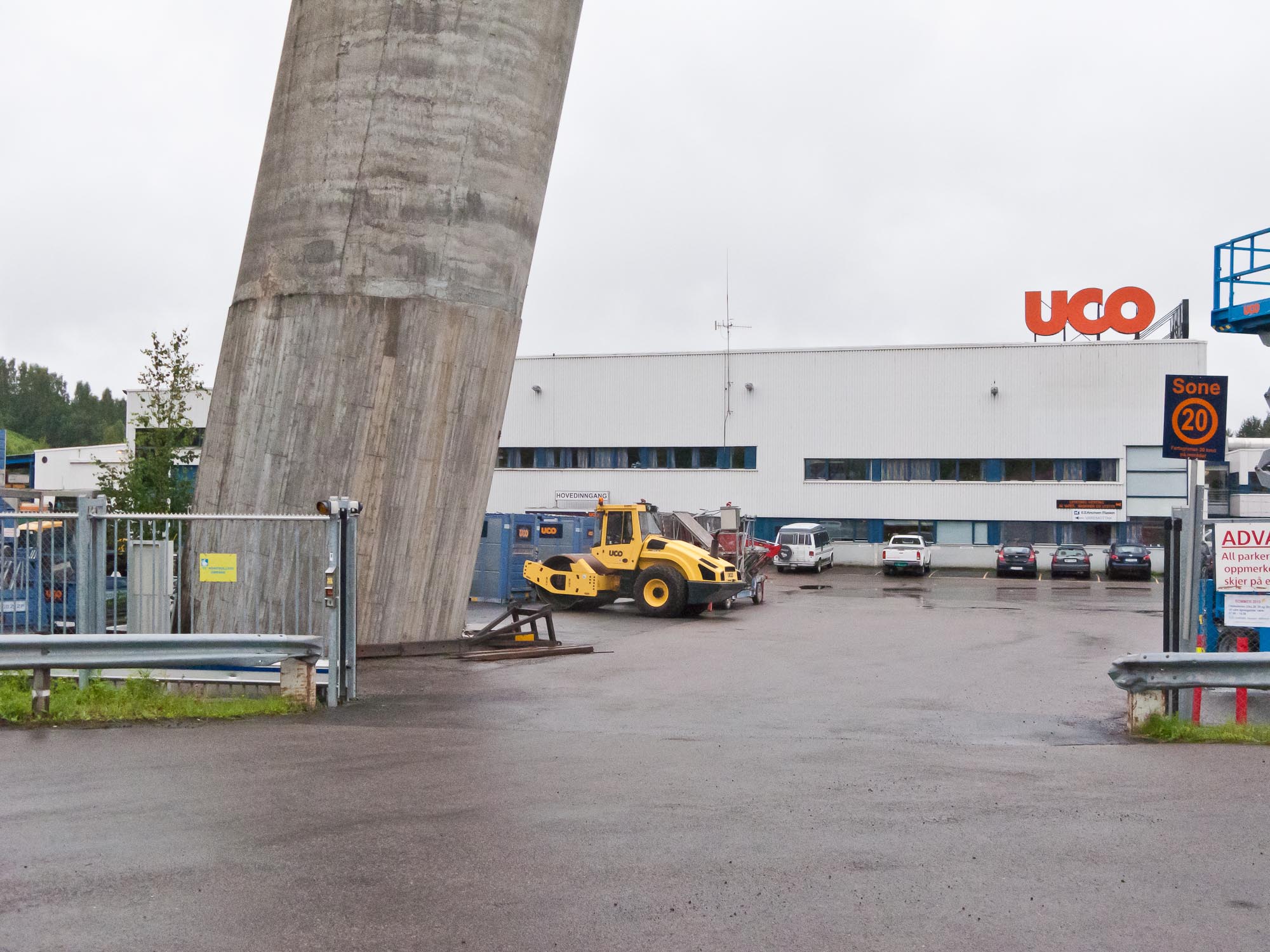
Located just outside the city of Oslo, this concrete tower actually does lean like this. It has an 11° lean off vertical, which is almost 3 times greater than the angle of the Leaning Tower of Pisa, which leans 4° off vertical. As far as I could determine, this tower's only purpose is to draw passing motorist's attention to the advertising sign on top of it. You can see this tower in Google Earth - the coordinates are 59.985163 North, 11.019493 East. ^

.

Here's another view of the base of the Oslo tower. ^

.

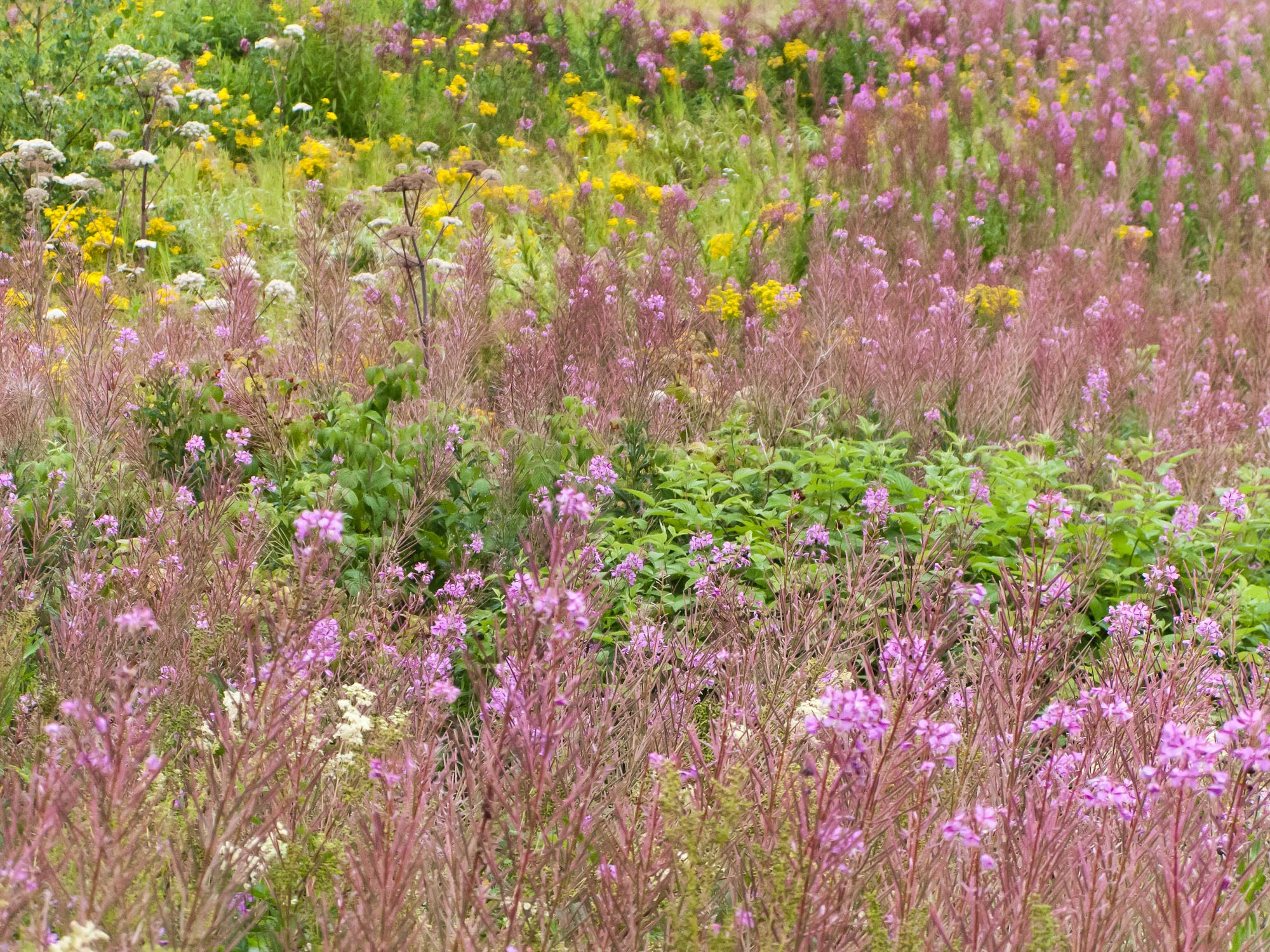
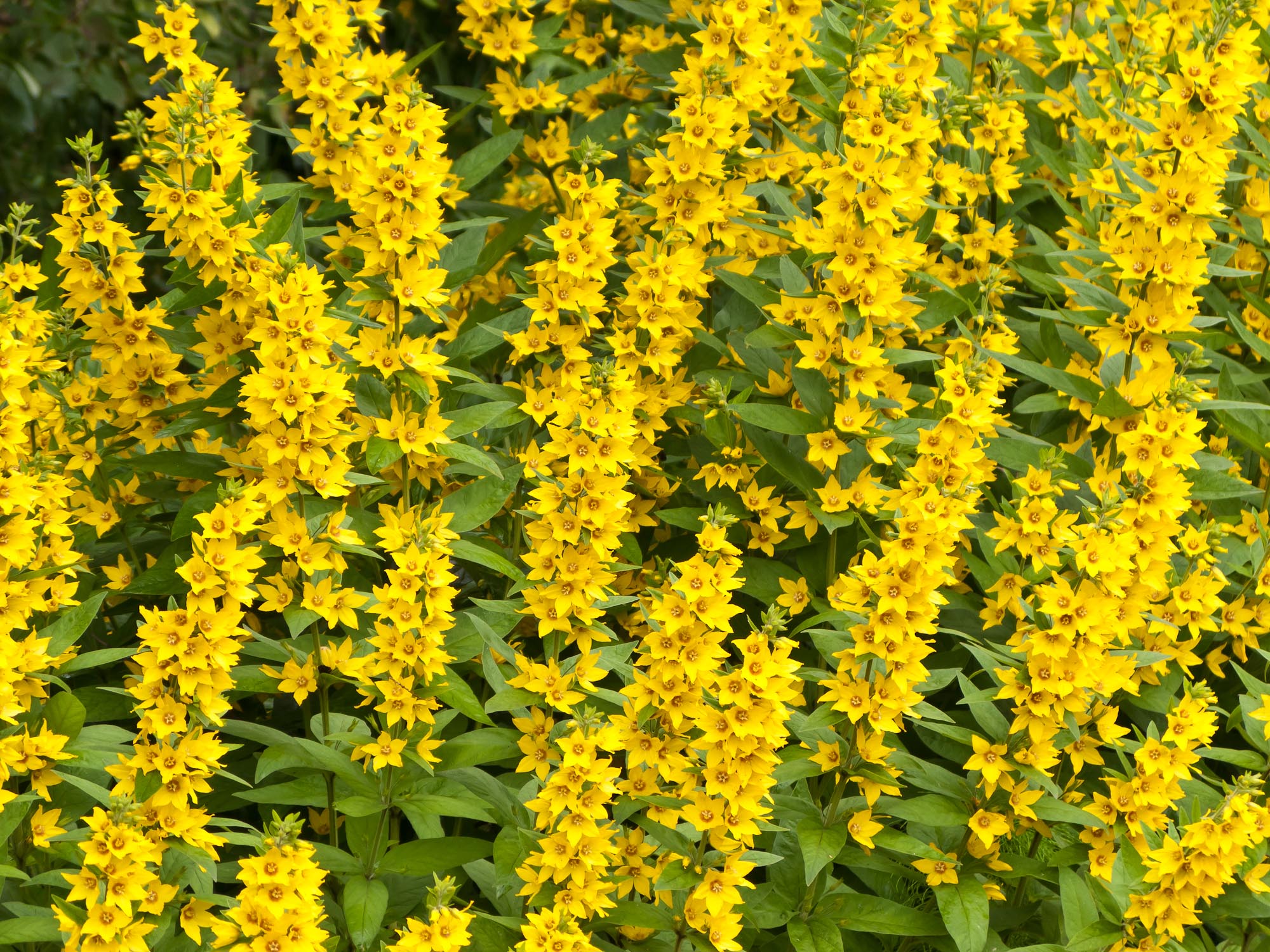
Wildflowers along the side of the road. ^

.

More wildflowers along the edge of the road. ^

.

Getting close to Oslo - it's about 10 miles away. ^

.

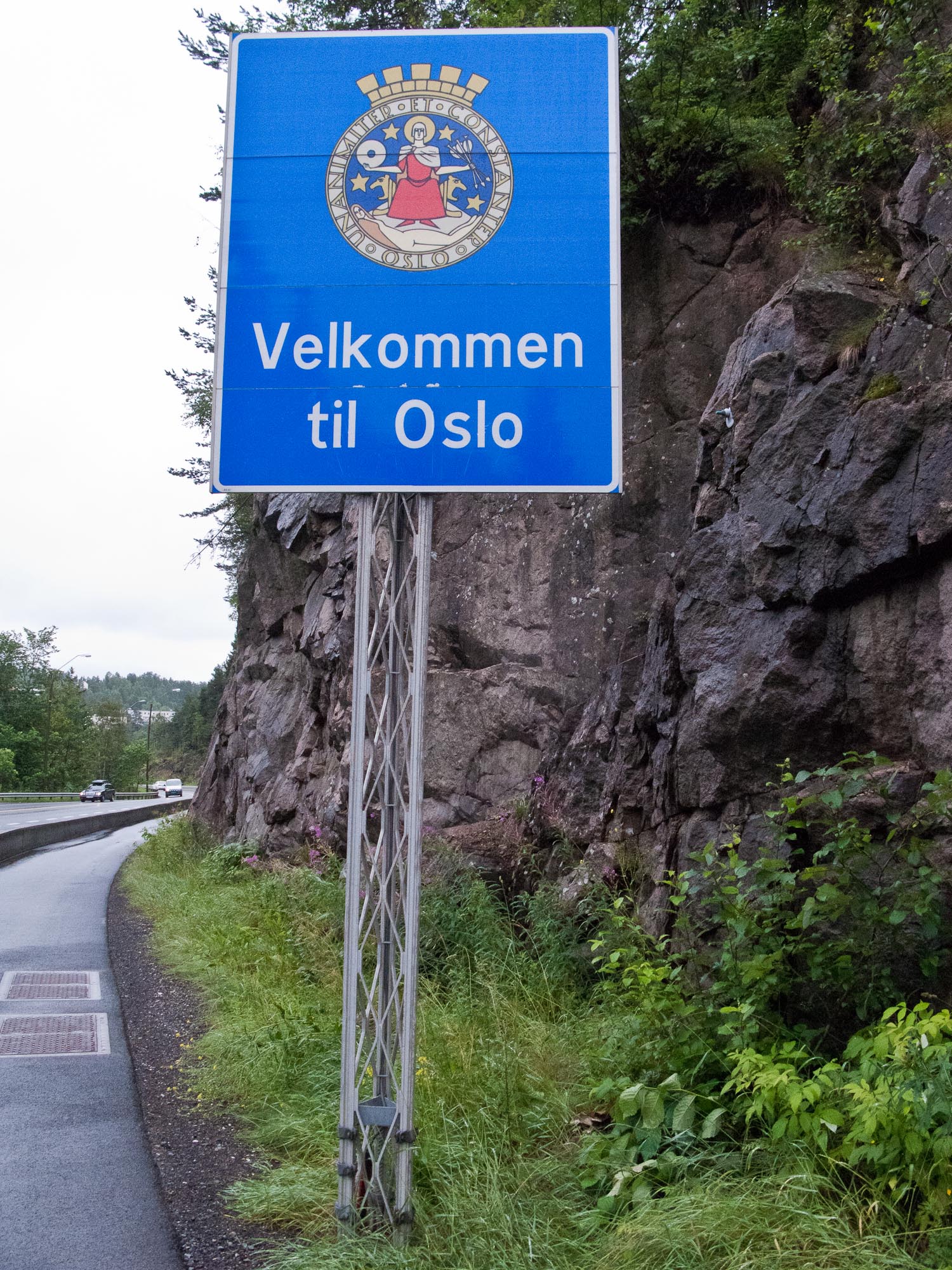
Entering Oslo, Norway. ^

.

This rock outcrop along the side of the road shows a textbook example of glacial erosion. ^

.

I’m now in a campground in Oslo. The campgrounds in Europe aren’t like the ones we’re used to in the U.S. Where our campgrounds are usually a just a tent site and picnic table in the trees, the ones here are more like city parks – open grassy fields where people just drive in and park their campers or set up a tent. But what this one lacks in privacy, it’s made up for with amenities – there’s a grocery store, showers, and full restrooms with running water. It’s actually a pretty good setup for a bike tourer.

.

Campground in Oslo. This is typical of European campgrounds.

.

I had an interesting experience with an ATM machine this morning. I forgot to check to see what the exchange rate was between U.S. dollars and Norwegian kroners. The only option on the cash machine was, of course, kroners. I had no idea how much to get, as it dispensed denominations of 100 and 500 kroner. Someone before me had left their withdrawal receipt at the machine, and it was for 2,000 kroner. So I just guessed and withdrew 500 kroner, which was about $80.

.

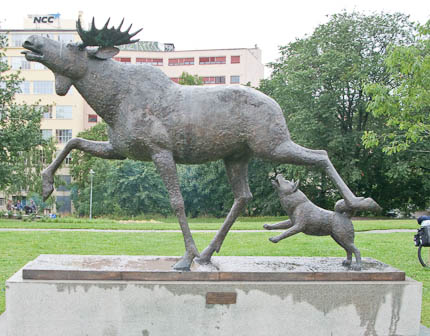
Sculpture of a wolf chasing a moose, in an Oslo city park.

.

There are some interesting sculptures in Oslo. This one was over a waterway near the city's waterfront.

July 25: Los Angeles to London and Oslo

Posted in England, On the Road on July 25, 2010 by Scott McGee

After riding first class from Los Angeles to London on British Airways, it’ll he hard to ride coach/economy class again. I was right up in the nose of the plane, and instead of having just an inch or two between my knees and the seat in front of me, I had a seat that reclined into a fully flat, 6.5 foot long bed which occupied the space of 3 coach-class rows. The service was amazing – there were three flight attendants for just 12 people in First Class, and upon boarding, they gave each of us a set of pajamas, slippers, and a fancy case full of soap, hand lotion, and face cream. After dinner, most people went to the lavatory to change into their pajamas, and while they were doing that, the flight attendants changed their seat into a bed, complete with pillows, sheets, and a blanket. I opted not to use the pajamas, as I noticed that they were one-size-fits-all, size extra-large and baggy. The whole thing was just too cheesy for me, so my pajamas, slippers, and soap/hand/face cream went unopened. I had the thought that I could put the stuff up on Ebay and make some cash, but I didn’t want the hassle of dragging that stuff around on my bike or mailing it home.

The food on board was pretty amazing, compared to the gruel that you get in coach/economy class. First, there was champagne, followed by appetizers and the main course and desert. Then, in the morning (it was a 10 hour overnight flight) there was a nice English breakfast of scrambled eggs, bacon, toast, fresh fruit, baked beans, and bangers (what the British call sausage).

.

Pre-appetizer: Some kind of meat (pretty good)

.

Appetizer: Salmon, asparagus, and caviar

.

Main course: Scallops, potatoes, and asparagus

.

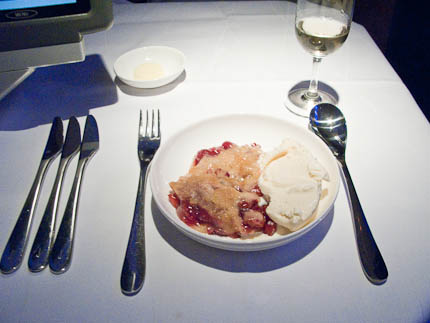
Dessert: Cherry cobbler and ice cream

.

Flying over the English countryside on the way to London

.

We landed at Heathrow Airport at 3:30 pm, which gave me just enough time to find the gate for my connecting flight to Oslo. It was just a short 1 hour and 45 minute flight to the airport 30 miles northeast of downtown Oslo. The weather was just like the typical Juneau weather – rain, low clouds, fog, and about 50 degrees F. I waited at the oversize baggage claim area for about an hour, hoping that my bike actually made it to Oslo. Fortunately, it did. By this time it was 9:00 pm and I wasn’t looking forward to putting my bike together and pedaling down the road in the rain to camp in a patch of trees that I saw on Google Earth, so instead I hopped on the first hotel shuttle that I saw (Best Western) and got a room for the night. I put my bike together in the room while watching a Vin Diesel movie that was in Norwegian instead of English – pretty funny.
July 24: Anchorage to Los Angeles

Posted in On the Road on July 24, 2010 by Scott McGee
I had to get up at 3:00 am in order to catch my 6:30 am flight out of Anchorage. Rather tough, not being a morning person. The cab that I reserved the day before arrived right on schedule to take myself and my boxed bike to the airport. No problems – until, after 1 hour of sitting on the plane at the gate, the Captain came over the intercom and announced that we were still waiting for all the checked luggage to be loaded. Seems the conveyor system in the terminal broke down and the ground crew was busy running from conveyor to conveyor to find all the baggage that was supposed to be on my flight. So I immediately had visions of arriving in Oslo sans bike. But they assured us that everything was loaded. I hope.
.

My bike and camping gear, all boxed up and ready for the long ride.

.

My airline tickets from Anchorage to Oslo. Notice the seat numbers - all First Class. Click to enlarge.

.
I was hoping to get a glimpse of the Juneau Icefield as we flew south out of Anchorage, but there was a continuous cloud layer from Anchorage to just north of Vancouver, British Columbia. But soon the clouds dissipated and I was able to get some nice views of the mountains north of Vancouver, British Columbia.
.

View of the coastal montains in southern British Columbia, on the way to Seattle. Click to enlarge.

.

Looking north toward Seattle. Sea-Tac airport is visible near the upper center of the photo. Mt. Baker is the large snow-covered mountain on the horizon. Click to enlarge.

.

After leaving Seattle for Los Angeles, we flew past Mt. Rainier. Here’s a photo of it from my left-hand window seat as we flew past it at 16,000 feet.
.

View of Mt. Rainier from the west. Click to enlarge.

.

Farm fields in the central valley of California. Click to enlarge.

.

Wow - look at all those exotic destinations. For me, it's British Airways Flight 268 to London. First time out of the U.S.! Click to enlarge.

.

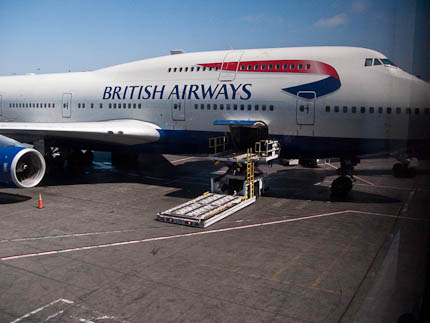
Here's my ride for the next leg of the trip - 10 hours non-stop from Los Angeles to London. My seat is right up front, windows 6, 7, and 8 back from the nose, but over on the left-hand side so that I can get a view of Greenland as we pass over it.

.
First Class definitely has its privileges over cattle-class. Wide seats, plenty of legroon, free meals and drinks, and real silverware (including metal knives and forks!). That was just on Alaska Airlines. I’m writing this from British Airway’s First Class lounge at the Los Angeles airport. This is definitely the way to go if you can stomach cashing in the requisite boatload of airline miles. All the free seafood, wine, champagne, snacks, etc. that you want, plus private showers! I loaded up on seafood and champagne and took a long hot shower, and can’t wait to get on the 747 an hour from now and settle into my First Class, 6-foot long sleeping pod for the 10 hour overnight flight to London.
.

The bar in British Airway's Fist Class lounge at the Los Angeles airport.

Final Preparations

Posted in Preparations on July 23, 2010 by Scott McGee

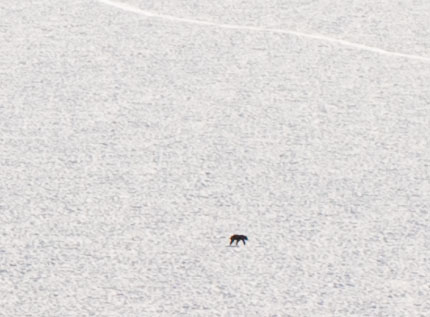
I returned home from three weeks on the Juneau Icefield today and am now doing the final packing for Europe. The weather this year on the Icefield was quite a bit worse than last year’s sunny first weeks. We had one day at Camp 17 when it snowed all day long, followed by a 10-day period of whiteout and rain which prevented helicoptering our GPS gear and other equipment from Camp 17 to Camp 10. Our best weather was from July 17 to 19. In addition to blue sky and sunshine, we had a rare visit by a black bear at Camp 10 on the 18th. We first noticed the bear walking west out of Icy Basin, and over the course of 3 hours it ambled around the base of the Camp 10 hill and into North Basin, staying about 1/4 to 1/2 mile away from camp. At one point it came to a meter-wide crevasse. It walked up to the edge, looked in, then backed up a few paces, got a running start, and jumped across. This was the second bear I’ve seen on the Icefield – about 10 years ago I watched a a grizzly bear traversing the Northwest Branch of the Taku Glacier.

.

View of a black bear on the Taku Glacier in front of Camp 10. The twin Taku Towers are in the left background. Click to view a larger version.

.

Close-up of the bear on the Taku Glacier. I took this with with a small point-and-shoot digital camera, so the quality isn't that great.

.

I’m now boxing up my bike and gear. I take off early tomorrow morning for Oslo via Seattle, Los Angeles, and London.

Another Nice Upgrade

Posted in Bike & Gear, Preparations on June 27, 2010 by Scott McGee

After upgrading my drivetrain to XTR components, it became apparent just how mediocre my original Magura brakes were. They were about 8 years old and the master cylinders no longer returned to the original position, and as a result the brake pads dragged on the rotors, producing a horrible squeal when braking. To counter this, I had to increase the distance between the pads and the rotor, but then I had very little braking power. It was barely tolerable when riding to and from work – there was no way the old Maguras were going to handle 2,300 miles across Europe – through, up, and over the Alps.

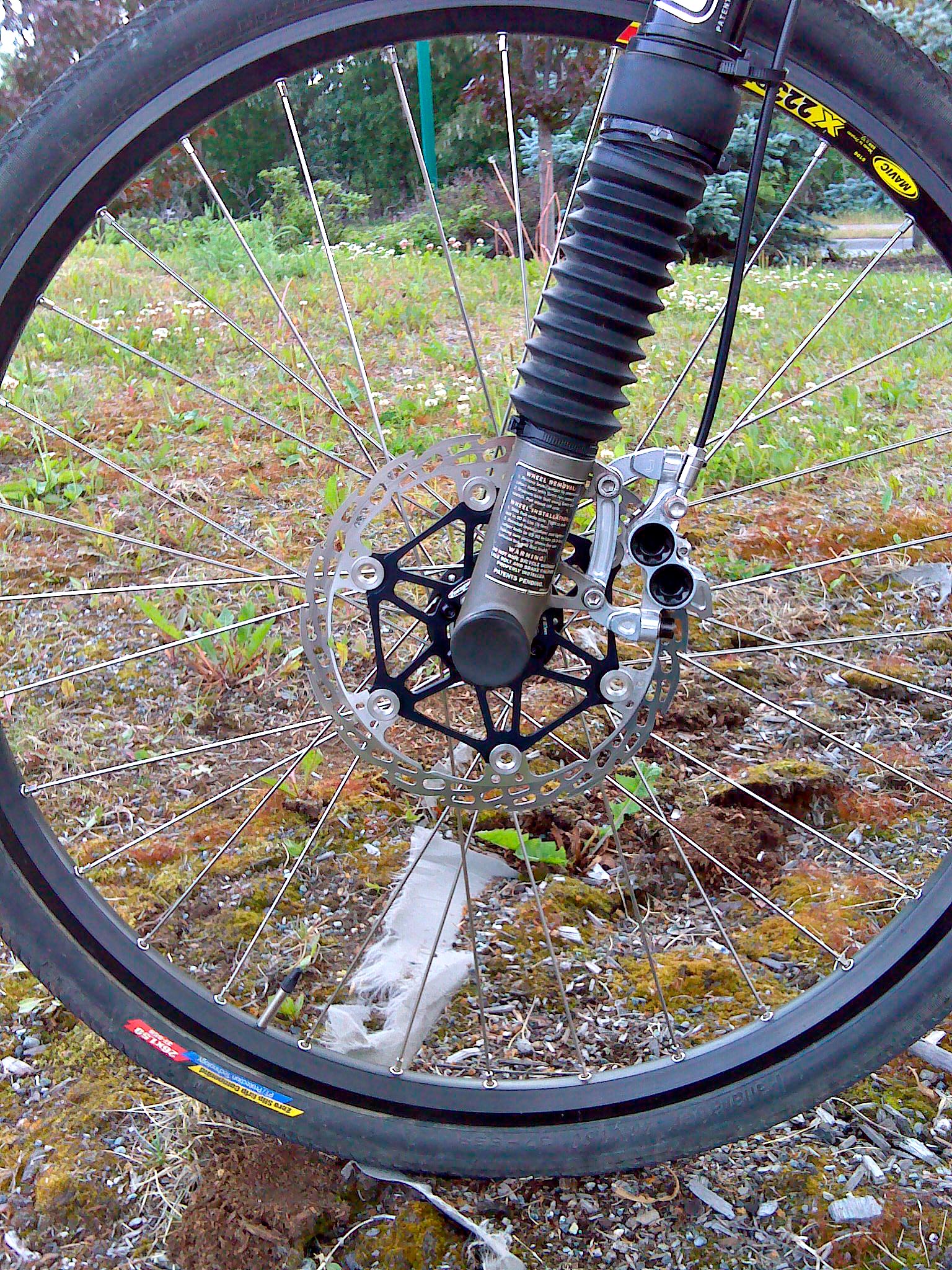
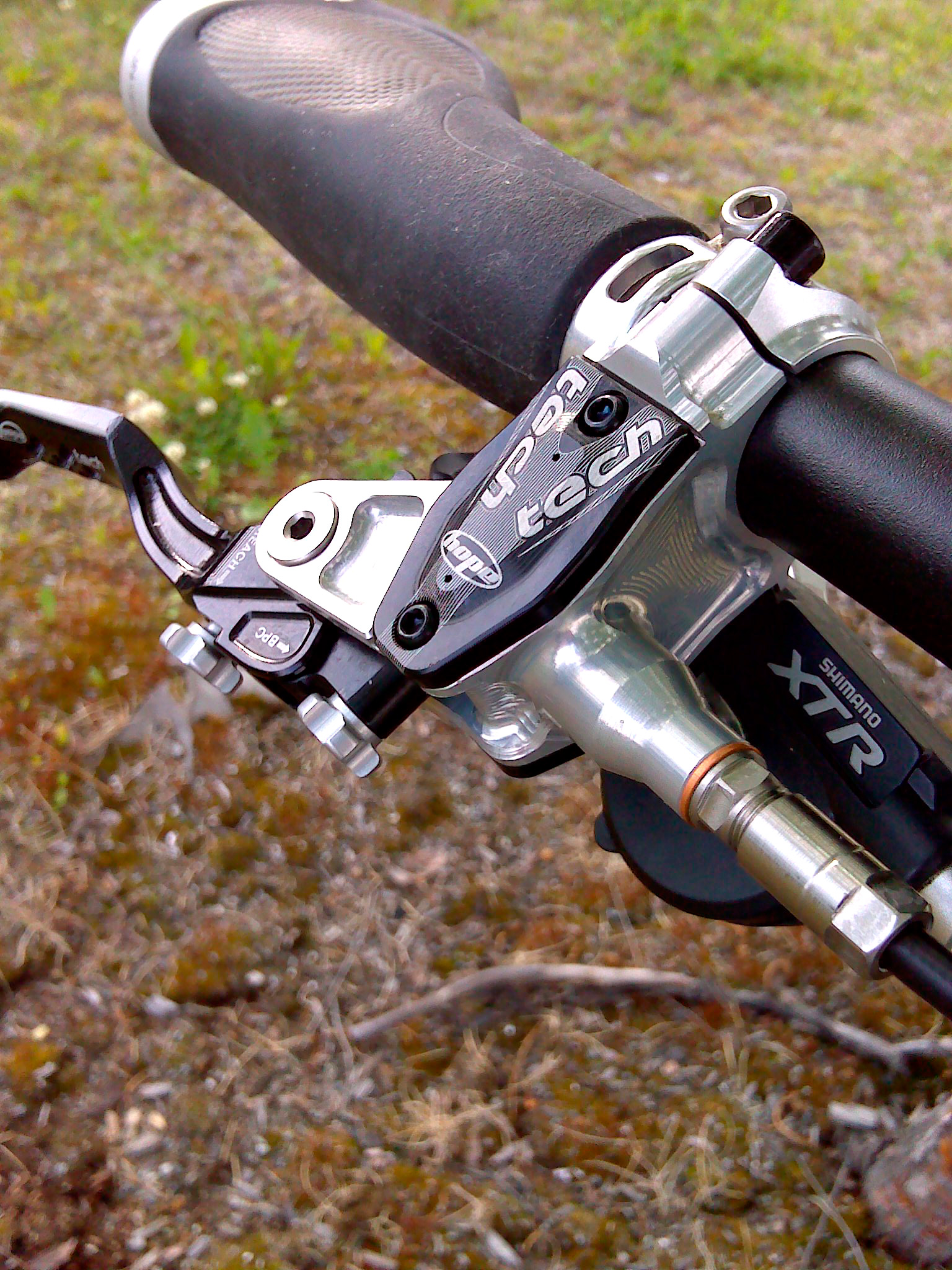
So, I once again opened the wallet (very wide) and upgraded. I replaced the Maguras with Hope Tech M4 hydraulic disk brakes. These are like the Ferrari of bike brakes. The calipers and lever bodies are CNC machined out of solid blocks of aircraft-grade aluminum. The calipers have 4 cylinders (2 on each side) providing the braking force. Of course, the important thing with brakes is how well they function – and these brakes are superb. But they also are just outright eye-candy – 100% bike bling! I had lunch at a downtown cafe today, and while I was eating there was a constant stream of passersby stopping and gawking at my bike. It was very entertaining watching them pointing at it and bending down to get a good look at the brakes. I saw more than one person mouth the word “Wow!” These things are just so much more than what people are accustomed to seeing on a bicycle. They have fantastic stopping power and look absolutely awesome – and despite the cost, they are definitely a worthy upgrade.

.

View of the front caliper and rotor

.

Close-up view of the left-hand side of the front caliper. The two black things are the caps on the cylinder bores. There are two additional cylinders on the right-hand side of the caliper.

.

Top view of the rear caliper. The entire caliper is carved from a single block of aluminum, rather than the typical design of having two separate halves bolted together.

.

View of the brake lever. Like the calipers, the lever body is machined from an aluminum block. The lever has two adjustment thumbscrews - one for the lever reach and one for the master cylinder "bite point", or the amount of lever action needed before the brakes kick in.

Trimming Pounds

Posted in Bike & Gear, Preparations on May 1, 2010 by Scott McGee

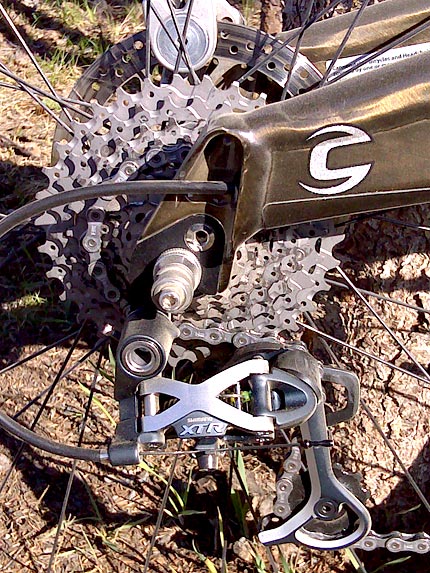
My OTR bike has 9,162 miles on its current components, and while the chain is a bit loose and I can’t hit all gear combinations, it’s still quite rideable for my typical day-to-day activities. Normally I’d keep riding until it’s obvious a part needs to be replaced, but I don’t want to worry about mechanical stuff on the OTR ride. So today I replaced the entire drivetrain – from the shifters all the way back to the rear cassette – with Shimano XTR components. It was an expensive retrofit, but it shaved another pound and a half off the weight of the bike. I’ll definitely appreciate that on the long uphill grinds through the Swiss Alps! And boy, it really is a sweet shifter now – I can hit everything from the lowest low gear to the highest high gear.

.

Bike with XTR components installed

My bike now sports an all-XTR drivetrain. Click to see a larger version.

.

Up front, there's a new XTR Hollowtech II crank and XTR front derailleur.

.

At the back end is a new XTR rear derailleur and XTR cassette. And it's all operated with new XTR shifters.

Goodbye Fat Tires

Posted in Bike & Gear, Preparations on April 26, 2010 by Scott McGee

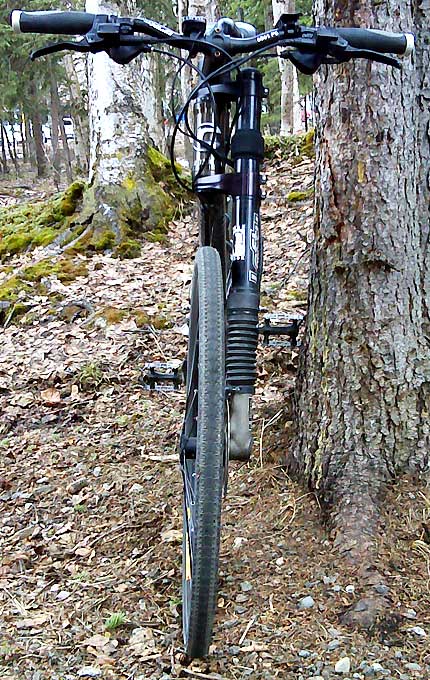
Front view of my funny-looking skinny tires (no, nothing's wrong with the fork - it's a Cannondale Lefty)

.

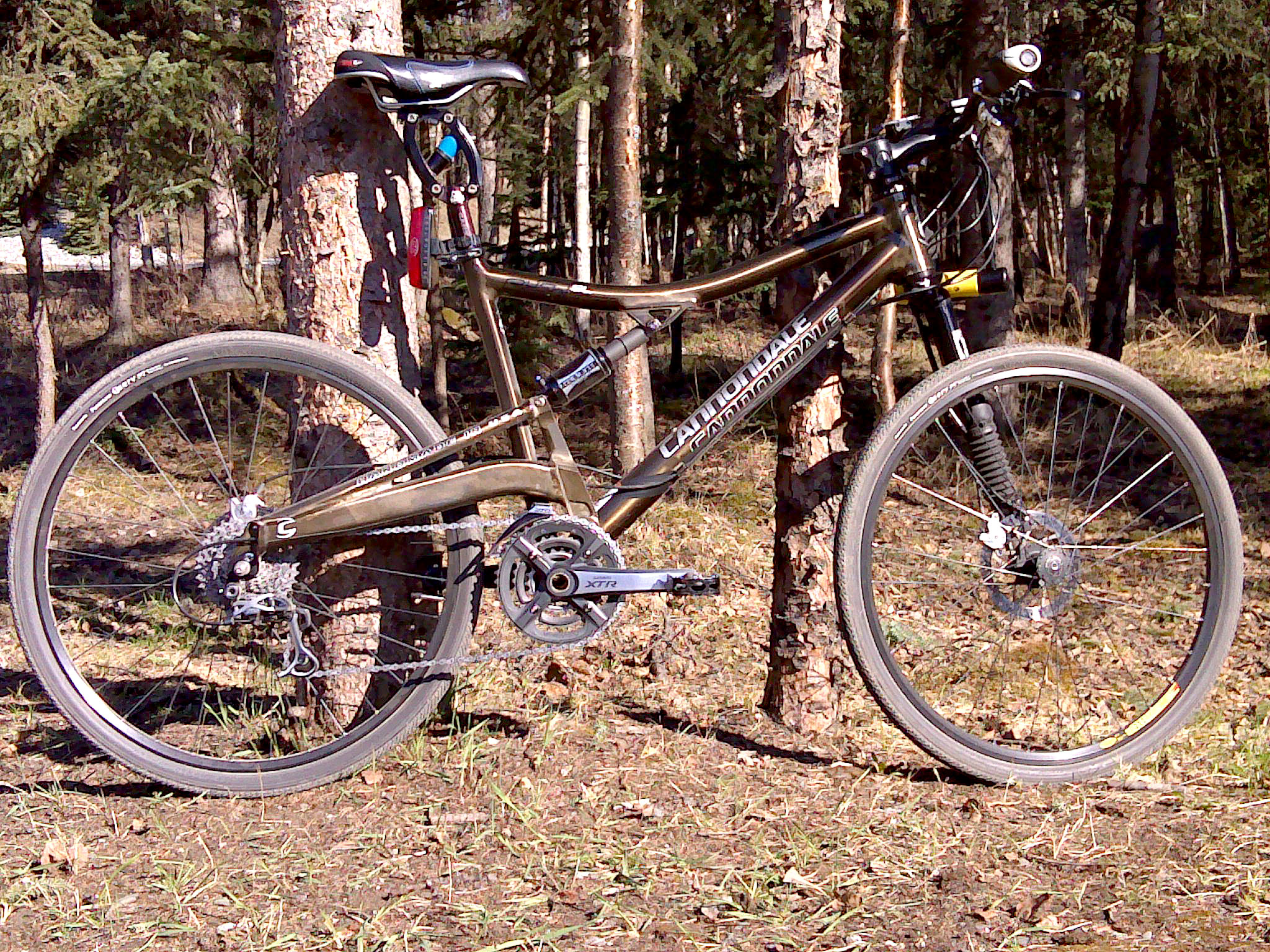
I wasn’t looking forward to cranking ~2,300 miles on my fat knobby tires, particularly when virtually all of those OTR miles will be on pavement. So today I  swapped my 2.1″ off-roads with 1.5″ Panaracer T-Serv road tires. I have to admit, it looks really weird now. I’m not used to seeing such skinny tires on my mountain bike – it’s kind of like looking at a low-rider car with tires that are three sizes too small. I’ll get used to it eventually. But the really great advantage is the drastically reduced rolling resistance of the skinny tires. In addition to being narrower than my off-road tires, they’re pumped up to 65 psi instead of 40 psi, and weigh 1 pound 2 ounces less. All this makes a big difference in pedaling effort – and the road tread is super quiet compared to the knobbys. I expect these quicker tires will cut at least an hour off my daily rides, leaving more time to sample some of the fine German beer that’s sure to cross my path.
.

A soft ride - full suspension plus a Thudbuster!

Riding Turnagain Arm

Posted in Bike & Gear, Preparations, Rides on April 24, 2010 by Scott McGee

We’ve been having a cool and cloudy spring in Anchorage, so when the weather forecast called for sun and a temperature around 50° F for today, I hoped it was correct. Well, it was, and I figured what better thing to do than go for a bike ride.

.

Carpathian Peak

Carpathian Peak rises 5,856 feet above the Seward Highway along Turnagain Arm in Alaska

.

I estimate I’ll need to average about 75 miles per day on the OTR ride, so to get an idea of what that would be like, I rode from Anchorage to Girdwood and back to Anchorage, a round trip of 80 miles. The route followed the Seward Highway along Turnagain Arm, which is the main highway from Anchorage to Seward. It’s a busy 2-lane highway, with a lot of curves and fast traffic. I normally stay away from roads like this, but I’ll have to ride similar roads on the OTR route, so I figured I should take a test ride and try to get acclimated to the idea of riding on the shoulder of the road a few feet away from speeding traffic.

As it turns out, it really wasn’t as bad as I thought it would be, which is surprising because of all the traffic that the sun brought out. As I said, we’ve had a cool and cloudy spring, so our first warm, sunny day spurred a lot of people to get out and take a drive. And the Seward Highway is, by far, the most popular drive in the Anchorage area, so there was a lot of traffic – big trucks, Corvettes, Mustangs, multitudes of noisy motorcycles, State Troopers patrolling and keeping the order, and even an old Ford Model T-type car. And although the traffic was whizzing by, my position on the shoulder of the road provided enough separation between myself and the vehicles that it felt safe enough. So I was able to enjoy the scenery and not worry about the traffic.

Total time for the round trip was 7 hours and 58 minutes, which included snack breaks. Riding time was 6 hours and 45 minutes, for a moving average of 11.5 miles an hour. Certainly not fast, but I wasn’t qualifying for the Tour de France, and this was on my mountain bike with knobby off-road tires. But I think it’s a fairly realistic example of what my daily OTR schedule will be like, so all-in-all it was a good test ride.

To see and explore my route on an interactive map, click here. Be sure to play around with the map to get the full effect. You can zoom in and out, pan around, and switch the type of base map. Try the Satellite and Terrain views, and for something really cool, try out the Earth view. If you currently don’t have the Google Earth plugin installed in your web browser, when you click the Earth button it will prompt you to download and install the plugin. Once that’s done, spend some time playing with it – it’s worth it! And after you’ve played with the map view, click Player in the upper right corner – that will let you play back an animation of my ride, complete with all sorts of statistics (TIP: play the animation in full-screen mode!!).

.

Dall sheep

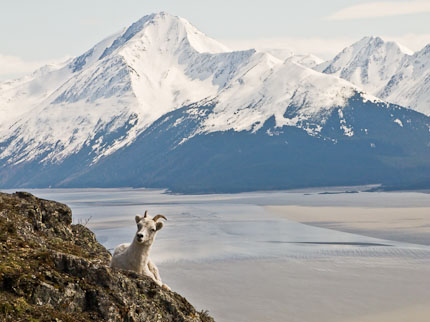
Dall sheep live on the mountainside above the Seward Highway along Turnagain Arm